

The Smart-Home Reset: What to Do With Connected Devices When Moving Into a New Property
smart technologies

Connected devices can retain account links, Wi-Fi details, access codes, schedules, recordings, and other settings after a household changes. That makes a smart-home reset one of the first technology jobs to handle when moving into a property. Guidance from the Federal Trade Commission stresses that connected devices and the router linking them to the internet need secure passwords, updates, and access controls.

Technology setup also works best when treated as part of the wider move-in process. While getting a place ready to settle in, homeowners can coordinate device resets with cleaning, utility activation, internet installation, lock checks, and a basic security review. Doing these jobs together reduces the chance that an old account, forgotten device, or temporary password stays active after move-in day.

1. Start With an Inventory

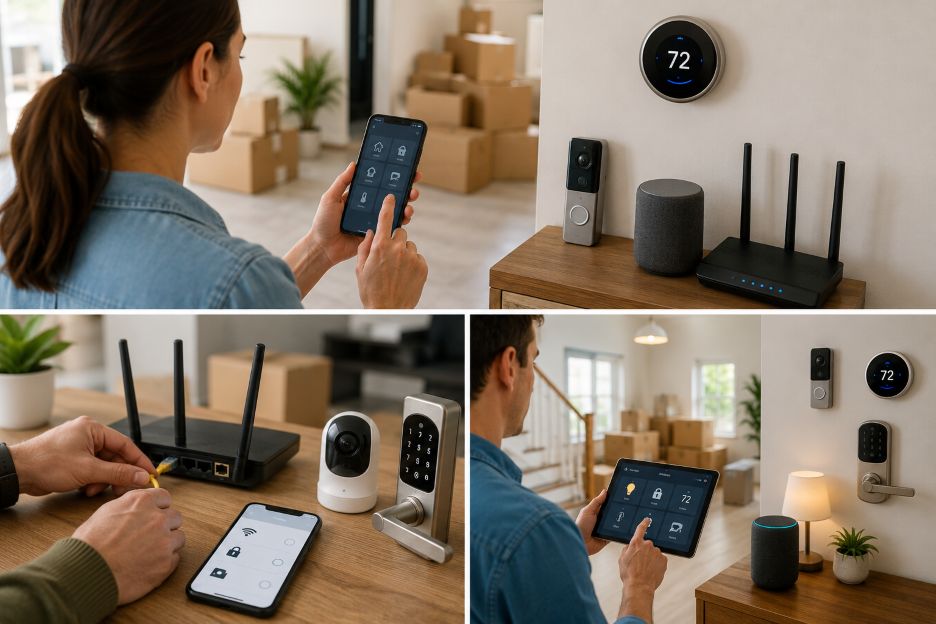
Walk through the property and identify every device that can connect to Wi-Fi, Bluetooth, a hub, or a mobile app. Examples include thermostats, video doorbells, indoor cameras, smart locks, speakers, displays, plugs, lighting hubs, garage-door controllers, and mesh-network equipment.

The National Institute of Standards and Technology treats device identification, configuration, data protection, access control, and software updates as core parts of IoT cybersecurity. An inventory shows what needs to be reset, updated, claimed in an account, or removed.

2. Reset the Router and Build a Fresh Network

The router should be handled before most other devices because it serves as the gateway for the home network. The Federal Trade Commission recommends changing default administrator credentials, using a unique network name and password, enabling available encryption, and keeping router software current.

If the property came with a router, do not assume its old settings are safe to reuse. Factory-reset it when appropriate, then create new administrator credentials and Wi-Fi details.

3. Clear Previous Owners From Thermostats

A pre-installed smart thermostat may still contain schedules, account associations, Wi-Fi information, or settings from the former household. Google Home and Nest Help advises residents with an existing Nest thermostat to have the previous owner remove it from their account when possible. If that cannot be done, a factory reset may be needed before pairing it with a new account.

After the reset, confirm heating and cooling settings rather than keeping the previous schedule automatically.

4. Treat Cameras and Doorbells as Privacy Devices

Cameras deserve extra attention because they may contain recordings, event history, Wi-Fi credentials, and cloud-account links. Google Home and Nest Help states that a factory reset on supported Nest cameras and doorbells returns personalized settings to defaults, removes stored network details, and can erase video history.

Before adding a camera to a new network, confirm that it is no longer tied to the previous resident. Then review recording settings and shared access.

5. Reset Smart Locks and Replace Old Codes

Smart locks should be treated much like physical keys. Old access should not remain active after ownership or tenancy changes. Google Home and Nest Help says a factory reset of the Nest x Yale Lock deletes user passcodes, including the master passcode, and returns programming settings to default.

After resetting a lock, create new codes for household members. Remove temporary codes when they are no longer needed, and confirm that the device is registered only to the new household.

6. Reclaim Speakers, Displays, and Voice Assistants

Smart speakers and displays can remain tied to user accounts, household groups, routines, and stored settings. Google Home and Nest Help says a factory reset clears data from supported smart speakers and displays and disconnects the device from members of the previous home. Apple Support also recommends resetting a HomePod before it changes hands.

Once reset, add the device to the correct household account and review linked services, personal results, and household permissions.

7. Add Devices Back Slowly

Connect devices in a controlled order instead of adding everything at once. Start with the router, then security devices, climate controls, hubs, speakers, lighting, and lower-risk accessories. The Federal Trade Commission recommends changing default passwords, using two-factor authentication where available, and enabling device security features. The National Institute of Standards and Technology also identifies secure software updating as a core IoT capability.

This approach makes troubleshooting easier and gives you time to confirm that each device appears under the right account. Connected features are also spreading beyond traditional smart-home equipment. The growing use of smart technology in modern power tools, including app-based controls, tracking, and configurable settings, shows how managing connected hardware is becoming relevant to many parts of the home and workplace.

A Secure Smart-Home Checklist for Day One

Before calling the setup complete, verify the basics:

  • Reset or remove devices still linked to a former resident.
  • Use new router administrator credentials and a strong Wi-Fi password.
  • Update firmware and apps.
  • Turn on multi-factor authentication where supported.
  • Create fresh smart-lock codes.
  • Review camera sharing and recording settings.
  • Check thermostat schedules and ownership.
  • Remove unused guest access and old household members.
  • Record device names, models, and recovery information securely.

A smart home should begin with clear ownership of the devices, accounts, and network that control it. Resetting first and reconnecting carefully creates a cleaner starting point. It also makes future maintenance easier because every device has been deliberately added, secured, and documented.
Smart Electrical Systems: What Industrial Facilities Can Teach About Building Automation

Industrial automation technologies are transforming how facilities manage energy, equipment, and building performance. Modern factories and processing plants increasingly rely on interconnected control systems that monitor operations in real time, helping improve efficiency and reduce waste. These developments are influencing how commercial buildings approach lighting installation and circuit work, especially as smart technologies become more accessible across different sectors.

modern industrial control room

Traditional Electrical Systems Versus Smart Infrastructure

Traditional electrical systems have supported commercial and industrial facilities for decades. Their design is based on fixed wiring, manual controls, and scheduled maintenance. Electrical panels distribute power through circuits, while lighting, heating, ventilation, and equipment often operate independently from one another.

This approach offers several advantages. Traditional systems are generally easier to understand, simpler to troubleshoot, and often require lower upfront investment. Many facilities continue to use conventional infrastructure because it has proven reliable over long operating periods.

Smart infrastructure takes a different approach. Connected sensors, automated controls, and centralized software platforms allow building systems to communicate and respond to changing conditions. Occupancy sensors can adjust lighting levels automatically. Smart meters can monitor energy consumption continuously. Building management systems can coordinate multiple functions from a single interface.

Research published by Lawrence Berkeley National Laboratory shows that advanced building controls can significantly improve operational efficiency by optimizing heating, cooling, lighting, and equipment performance. Data collected from sensors helps facility managers make decisions based on actual operating conditions rather than assumptions.

The debate between traditional and smart systems is not simply about replacing old technology. Each approach offers distinct benefits depending on facility size, operational complexity, and maintenance capabilities.

Advantages and Limitations of Automation

Supporters of building automation point to several measurable benefits. Energy management is often the most visible advantage. Smart systems continuously collect performance data and can automatically adjust operations to reduce unnecessary energy use.

The U.S. Department of Energy notes that building automation systems can help commercial facilities identify inefficiencies, optimize equipment schedules, and lower operating costs. Automated fault detection can also identify potential issues before they become major failures.

Another benefit is improved visibility. Facility operators gain access to real-time information about equipment performance, environmental conditions, and power consumption. Instead of relying solely on periodic inspections, teams can monitor critical systems continuously.

Automation can also support occupant comfort. Smart lighting controls can adjust brightness based on daylight availability. Environmental controls can respond to occupancy patterns throughout the day. These adjustments can improve user experience while reducing energy demand.

However, automation introduces challenges as well. Initial installation costs can be higher than those of conventional systems. Advanced controls require specialized expertise for design, programming, and maintenance. Cybersecurity concerns have also become increasingly important as more devices connect to networks.

The National Institute of Standards and Technology (NIST) has highlighted the importance of cybersecurity practices for industrial control systems and connected building technologies. As facilities become more interconnected, protecting operational technology becomes part of overall infrastructure management.

Critics of extensive automation sometimes argue that excessive dependence on software may complicate maintenance. When systems fail, troubleshooting may require both electrical and information technology expertise. This can increase training requirements and create new operational dependencies.

These competing viewpoints illustrate why many organizations adopt a balanced approach rather than fully embracing one model over the other.

Industrial Case Examples

Industrial facilities provide valuable examples of how automation can be implemented effectively.

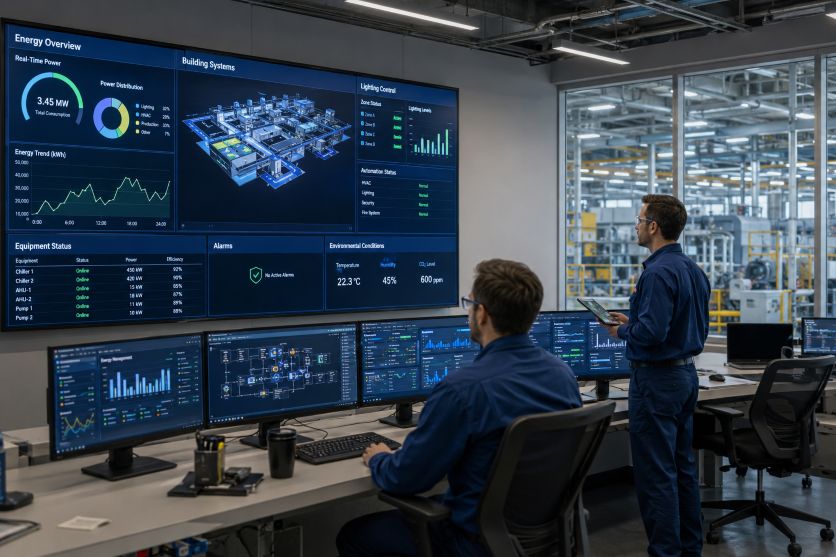
Manufacturing plants often use supervisory control and data acquisition (SCADA) systems to monitor production processes. These systems collect data from equipment, sensors, and controllers, providing operators with real-time visibility into facility operations.

The International Energy Agency (IEA) reports that digital technologies are increasingly helping industries improve energy efficiency by enabling better monitoring and optimization of industrial processes. Facilities can identify inefficiencies quickly and make adjustments that would be difficult to achieve through manual observation alone.

Large distribution centers also demonstrate the benefits of smart infrastructure. Automated lighting systems frequently use occupancy sensors and daylight harvesting controls. Areas with limited activity receive less illumination, while active work zones maintain appropriate lighting levels.

Data centers represent another important example. These facilities depend heavily on continuous monitoring to maintain reliability. Sensors track temperature, humidity, power quality, and equipment status around the clock. Automated responses help prevent downtime and improve operational resilience. Similar trends can be seen in other sectors adopting technology-driven equipment management, where connected sensors and intelligent controls help optimize performance, reduce waste, and improve operational efficiency.

At the same time, many industrial operators maintain traditional backup systems. Critical processes often include manual overrides and redundant controls to ensure continued operation during software failures or communication disruptions. This hybrid strategy reflects a practical understanding that reliability remains the highest priority.

Implications for Modern Building Electrical Work

The lessons learned from industrial environments are increasingly influencing commercial building design.

Electrical contractors and engineers now encounter projects that combine conventional power distribution with intelligent control systems. Modern building projects often require integration between lighting controls, energy monitoring equipment, occupancy sensors, and communication networks.

This evolution changes how electrical planning is approached. Circuit layouts must account for both power delivery and data communication requirements. Lighting systems may include programmable controls that interact with centralized management platforms. Electrical installations are becoming part of larger digital ecosystems rather than isolated infrastructure components.

Professionals working on commercial construction projects increasingly need knowledge that extends beyond traditional wiring practices. Understanding sensors, networked devices, and building automation protocols has become valuable alongside core electrical expertise.

Yet conventional electrical principles remain essential. Smart systems still rely on dependable power distribution, proper grounding, circuit protection, and code-compliant installation practices. Advanced controls can only perform effectively when supported by reliable electrical infrastructure.

This balance reflects a broader industry trend. Automation expands capabilities, but foundational electrical engineering continues to provide the framework that makes these technologies possible.

Long-Term Technology Outlook

Building automation is expected to continue evolving as sensor technology, artificial intelligence, and connectivity become more sophisticated.

The International Energy Agency and World Economic Forum have both identified digitalization as a key factor in improving energy management and infrastructure efficiency. Future systems may use predictive analytics to anticipate maintenance needs, optimize energy consumption, and support sustainability goals more effectively.

Artificial intelligence may further enhance decision-making by analyzing large volumes of operational data. Buildings could automatically adapt to occupancy patterns, weather conditions, and energy pricing signals with minimal human intervention.

Despite these advancements, the future is unlikely to be defined by complete automation alone. Industrial facilities demonstrate that successful infrastructure combines technology with practical operational oversight. Human expertise remains essential for interpreting data, managing risks, and making strategic decisions.

The ongoing discussion between traditional electrical systems and smart infrastructure is therefore less about choosing one side and more about finding the appropriate balance. Industrial facilities have shown that automation can deliver meaningful benefits when applied thoughtfully. Modern buildings can learn from these experiences by integrating intelligent controls while maintaining strong electrical fundamentals. As technology continues to advance, the most effective facilities will likely be those that combine reliable electrical foundations with carefully implemented digital capabilities.